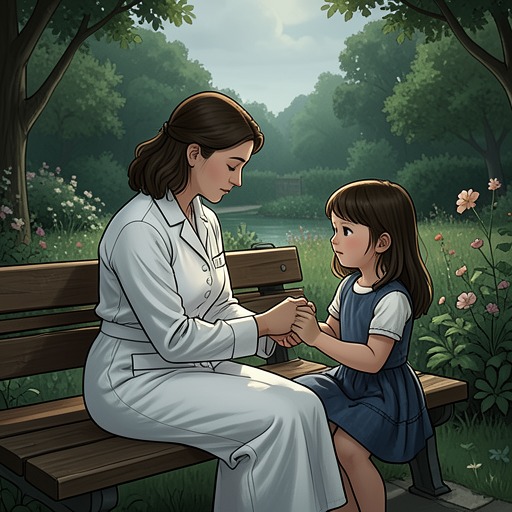
Tommy asks for a new carer
Never Let Me GoTommy’s request that Kathy arrange a different carer is a late, intimate reversal in their relationship: he asks to separate her professional role from their love just as his fourth donation approaches and his health is worsening. The exchange briefly reopens the divide between carer and donor, but it ends in reconciliation. Kathy accepts that she should find him another carer, while Tommy makes clear that his choice is not a withdrawal of affection.## Background and circumstances By the time Tommy raises the subject, Kathy has been caring for donors for more than eleven years and is expected to continue until the end of the year, bringing her service to almost twelve. She has developed an instinct for when to stay and comfort a donor, when to give space, when to listen, and when to encourage someone to stop dwelling on distress. Her donors have generally recovered better than expected and have rarely been classified as agitated. Yet the work depends on emotional involvement, and Kathy recognizes that choosing donors with whom she shares a past has helped her sustain it. She has been allowed to choose for only the last six years, and that choice helped her reconnect with Ruth and Tommy after their years apart.
Her return to Ruth begins at a recovery centre in Dover, where Kathy arranges to take over Ruth’s care despite Ruth already having a carer. Their old differences do not disappear, but shared memories of Hailsham create a bond that no one else can fully share. When their relationship becomes strained again, talk of a stranded boat gives them a subject they can approach together. Kathy encourages Ruth to talk about the boat after hearing that its story is travelling from centre to centre; the small shared interest helps reopen conversation between them.
After Ruth’s second donation, Kathy visits her in hospital three days later. Ruth is alone, in severe pain, and only briefly lucid. Kathy sits beside her, holds her hand, and stays as long as the staff allow. In one short moment when Ruth recognizes her, Kathy promises that she will become Tommy’s carer as soon as she can. That promise shapes the later request: Kathy has come to Tommy not only as a trained carer but also to fulfil what she understands as Ruth’s wish for them.
Tommy and Kathy have already been discussing his fourth donation. Donors respond to a fourth in different ways, and those approaching it often receive a special, almost congratulatory respect from other donors and from medical staff. Tommy tells Kathy that people worry because they cannot be sure they will complete. The uncertainty is sharpened by frightening talk about what might follow a fourth donation: further procedures without recovery centres, carers, or friends. Kathy dismisses this speculation as rubbish, though she knows she has no evidence to support her reassurance. Their failure to continue that conversation leaves a fear between them that becomes more immediate as Tommy’s condition deteriorates.## The request in the field About a week after notice arrives for Tommy’s fourth donation, he asks Kathy to walk with him through the field at Kingsfield. The grounds are limited: beyond the central Square, the largest open area is a rectangle of overgrown weeds and thistles enclosed by wire mesh. On this foggy morning, the field is wet, and they are alone. After pushing through the vegetation, Tommy stops by the fence and asks Kathy to arrange a different carer.
Kathy says the request does not surprise her, although it angers her. Tommy explains that it is not simply because the fourth donation is approaching. He has recently had kidney trouble and expects more problems as his condition advances. Kathy answers that this is precisely why she came back to help him, and reminds him that Ruth wanted it too. Tommy distinguishes Ruth’s wish for Kathy and him to be together from the question of who should care for him through this last part. He does not want to be in that condition in front of Kathy.
The disagreement turns on different kinds of knowledge. Kathy insists that she is the person who came back to help him; Tommy replies that Ruth would have understood his wish because she was a donor. He does not claim that Ruth would necessarily have wanted the same arrangement for herself, but he believes she would have understood his desire to do things differently. His remark that Kathy cannot see it because she is not a donor stings most. It places her outside the shared experience she has tried to honour through her care, and recalls how Tommy has sometimes made her feel excluded from donors’ lives.
Kathy walks away rather than continue the argument. The confrontation does not become a major fight: she returns to Tommy’s room, and he follows several minutes later. By then both have cooled down. Their conversation is stiff, but they make peace and discuss the practicalities of changing carers. The request therefore becomes something they can negotiate together, even though its emotional cost is not erased.## Reconciliation and separation Once the immediate anger has passed, Tommy asks whether Kathy is tired of being a carer and whether she sometimes wishes that she, too, would receive notice to become a donor. Kathy says that she does not mind and that good carers matter. Tommy questions whether it matters so much in the end, since donors will donate and complete regardless of who cares for them. His challenge places the value Kathy has found in her work beside the system’s impersonal certainty: her care can ease a donor’s experience, but it cannot change the course laid out for them.
Tommy concedes that Kathy is a very good carer, but says she would be the perfect one for him if she were not herself. He puts an image to the separation he is asking for: two people holding one another in a fast current until the water becomes too strong and they have to drift apart. He connects the image to the fact that he and Kathy have loved each other all their lives, while acknowledging that they cannot remain together forever. His explanation recasts the request as an attempt to preserve their closeness from the exposed, unequal demands of his care, not as proof that he loves her less.
Kathy apologizes for losing her temper and promises to speak to the people responsible, trying to ensure that Tommy gets someone good. Her response accepts the practical decision while continuing to express care through it. The weeks before the new carer takes over are unexpectedly tranquil. Kathy remains busy with other donors in North Wales, but still visits Tommy at Kingsfield three or four times a week. In his room they sometimes have sex, more often talk, or listen as Kathy reads; Tommy occasionally takes out his notebook and sketches ideas for new animals while she reads from the bed. These ordinary visits show that changing the carer does not immediately dissolve their intimacy. Instead, the separation is approached gradually, through a decision neither of them mistakes for a cure or a reprieve.## Significance The scene brings professional caregiving and private attachment into direct conflict. Kathy has chosen Tommy because their shared past makes it possible for her to care deeply, and because she promised Ruth she would. Tommy, however, needs to decide how he will meet the bodily decline ahead and how much of it he can bear to expose to the person he loves. Their argument demonstrates that affection does not automatically make care easy: the closeness that enables Kathy to comfort him can also be what makes his vulnerability unbearable.
The exchange also gives concrete force to the uncertainty surrounding donation and completion. Tommy’s fear is not simply about the announced fourth procedure; it includes rumours of what may follow and the possibility that neither donors nor medical staff can say with certainty where completion leads. Kathy cannot answer that fear with knowledge. Her first response closes down the subject, but Tommy’s request makes the limits of reassurance visible: what she can offer is presence, practical help, and the promise of a good replacement. In accepting the change, she does not abandon him; she recognizes that care sometimes means respecting the boundary the person receiving it sets.
Their quiet reconciliation contrasts with the irreversible structure around them. The two can make peace, continue their visits, and choose how to spend the remaining weeks, but neither can alter the donations that determine Tommy’s future. The request is thus both a small practical arrangement and a final assertion of personal agency within a life governed by procedures. Its resolution is tender without being a reprieve: Kathy remains devoted, Tommy remains loved, and the carer’s role must nonetheless pass to someone else.